Future of Accounting◆
Recorded October 202629 min
Pilot's co-founder on what changed when the production work moved to AI: value-based pricing, incentives tied to outcomes, and where to start a rollout.
- Jessica McKellarCo-Founder and CEO, Pilot, creators of Meridian
Drop in your work email to watch. The transcript below is yours either way.
No spam. Unsubscribe anytime.
Transcript◆
It's a phenomenal tee up for bringing us back to accounting specifically. I think that this is the most exciting time to be leading an accounting firm or an accounting practice and within a firm in the history of accounting, and I'm excited to talk about this with you. I do think I have a unique vantage point on this because of my background. My original, original background is in computer science at MIT, but I have also run an accounting firm for the past ten years and I have specifically run an accounting firm that is of living at the forefront of how AI can be applied to accounting.
And so I've learned a lot, and I'm excited to share it with you. So the first point that I want to make that will jive with what Pat was just saying is that the production accounting work can be delegated to AI today. This is not a tomorrow thing, this is not a speculative thing, this is true today, and there are many firms who are living in this world, and then most firms are not. And this is important to really digest because if you have a foundation where the production work, the bookkeeping, the month end close, the tax prep, the FP and A, where that work is delegated to AI agents, it gives you an opportunity to fundamentally restructure how
you are organized and operated in a way that is a rare win win win. It's actually a better client experience, it's a better employee experience, and it yields a stronger and more resilient firm, a firm that has better economics but is also going to be more resilient to the accelerating pace of change. I'm going to motivate this with a concrete example, which is Pilot as the test lab for Meridian.
Meridian is a purpose built AI operating system for accounting firms. Meridian is an accounting firm that serves over 4,000 businesses on Meridian.
Pilot was started over... It was about ten years ago, so we have been running this firm from the pre LLM, like pre modern AI days, to the now, and we have learned a lot from doing that. Our experience has been that we can now, delegating the production work to Meridian and then reformulating the team on top of that, Our goals for our team are that our individual accountants are serving million dollar client revenue portfolios, so every accountant at Pilot is managing a million dollar revenue portfolio.
That's great, that's great for margins, it's great for how that margin that we've reclaimed can be accrued back to the employees in the firm. It has also resulted in a better client experience and if I look out at the audience and I know folks who are looking at their watch because it's tax season or it's the thirtieth of the month and we're about to tick into a new month end close, I went through for eight years always having overdue work.
Some client was at the end of the queue. It was so hard to manage capacity in a way that met our client needs and met our margin needs. Someone always got the short end of the stick. Pushing the production work to AI reduces the workload, but it also reduces the variance in a way that makes capacity planning much easier and it makes our recurring work much more predictable.
Better client experience, but a vastly better employee experience. The team wants to do a good job. It wants to go the last mile for clients, and we sometimes just can't because we don't have the staffing for it. We're living in the world of the highest employee satisfaction and retention that we've ever had due to less operational stress, and also it doesn't hurt that there's increased compensation aligned to outcomes. Some of that margin increase has accrued back to the team.
At the end of the day, this is about building a firm that has strong economics, that can scale easily. The way that Pilot can operate, and I think you'll find that this is true if you're able to live in this model, is we have unlimited onboarding capacity. The onboarding is done mostly in software, so the door is always open. Nothing that the sales team likes more than that. It's easy to maintain our client base, but it's also very easy to scale.
I feel like I live in a beautiful future, and I just want a lot more people to live in this world. This is the state of the art today with Pilot. This is a motivating example to talk about what transformation process is required to get from the pre AI world to the now. It's been ten years in the making. This is the process that we went through, and I think it is basically a universal process.
Firms adopt AI successfully. This is basically an incentives problem at the end of day. It's actually not a tech problem, it is mostly an incentives alignment problem. Firms, as far as I know, only adopt AI successfully when incentives between the firm, employees, and clients are all aligned. This starts with adopting value based pricing. I know a lot of firms in this room are already there, a lot of firms are not we'll talk more about that in a second.
You then need to align incentives with outcomes at all levels of the firm, from the top down to the folks owning the production work, and that's when you're really well poised to implement a radical tech stack that will radically improve your metrics.
Before we get into each of those three stacks, I emphasize want that this transformation is a tech plus people transformation. I say that because a common failure mode that I see with firms is that they treat it as a tech transformation. The people side gets left behind and they're surprised when they don't see results. In a pre AI firm, accounting firm, generally speaking, your tech stack is about tools supporting human production.
Then you have a people stack that is around the right roles and rewards alignment to the effort of the work that I did. I did a bunch of manual work. I had seven billable hours per day. I am recognized for the effort, not the outcomes. In an AI native firm world, the production work is delegated to software, it's delegated to AI. First, the roles are going to change.
If the production work is being done in software, it means that people aren't doing that. They're either doing something else or they're not there, and then what's left is the responsibility for the client engagement, the ownership of the work product because you can't blame AI if there's a mistake, it's your client, but the ownership of the work product and the client relationship and successful client outcomes.
That can be a really big transition in terms of what profiles you're hiring for and what the career progression can look like. I want to emphasize that the transformation is tech plus people. Let's talk about value based pricing. Why is this important? This is an obvious statement, but I'll say it to say it. If you're not on value based pricing, you're probably billing hourly.
And the challenge with that is if you automate the work, then the amount of time spent doing the work goes down, so the number of hours that you can bill goes down, so now your revenue has gone down. That is not a recipe for successful AI adoption or positive firm economics. We need to align AI adoption with improvements to profitability, and value based pricing is going be the main way to do that.
I want note that value based pricing is not the same as a fixed fee model because you can get yourself into a little bit of a trap with a fixed fee model where you're like, okay, I'm scoping this advisory relationship and they want X, Y, and Z recurring deliverables and we're going to have four hours of phone calls every month and we're going to price that out. We think it's about twenty hours of work and so we're going to do some math on that to price out the engagement.
That is mostly hourly billing by another name, and it's to
demotivate the investment in AI, so I do mean value based pricing when I say value based pricing. It also aligns employee incentives with adoption. We'll talk more about employee incentives in a second, but if you're an IC on the team, you're a bookkeeper, you're a tax preparer, you're a CFO, and your boss is like, Hey, your job is to have seven build hours a day. If you were to be really good at automating your work, your reward would be more clients to worry about to fill those seven hours.
You want to be rewarded for working smarter, not harder, and you can't do that with hourly billing. Last thing is that clients usually like it. Like the predictability and the transparency. They don't feel like they're being taken for a ride, like, oh, I'm going to get billed as many hours as the firm thinks I will tolerate. Again, lot of folks in this room have already gone through this, but the hard part is usually, number one, doing it more universally within a firm for all recurring deliverables.
Maybe the bookkeeping was easy to move to value based pricing on, maybe the CFO advisory is harder because it tends to imply some standardization of process. So really adopting this across all recurring deliverables and common engagements. Then the other hard part is what do you do about your legacy client base? You have folks, they've been clients forever, they're used to the hourly billing model, and you'd have
to have an explicit conversation with them about moving to a different billing model. I recognize that that's hard. It is necessary if you're going to see real upside from AI though. If you have a thousand legacy client base and you're only moving to value based pricing for the go forward clients, what's going to happen with all those thousand clients and the people who work on them? Step one is we have to live in a world of value based pricing.
Then we're well positioned to align incentives with outcomes at all levels of the firm. What do I mean by that? This is about compensation. It's about recognition, it's about promotion. This is mostly about compensation and I think this is an area where there's an opportunity for the folks in this room to really be innovators and leaders because candidly there aren't a lot of examples for firms to pattern match off of.
I think in a lot of firms, you have a salary. You have a salary and that salary marches up over time as you continue in your years with the firm. What do I mean when I mean aligning incentives? We want to align your incentives with the outcomes that the firm is trying to drive. The people in charge of a firm, the partners, the CEO, the practice, the people who run a particular service line within the practice,
if your comp would be the same, if your career trajectory would be the same whether or not you successfully invest in these tech transformations and you successfully drive business metrics, then that's not a motivating comp strategy for your leadership team. There has to be upside for putting in the work of the change management of all of this and to be ambitious on this. There are the folks who are evaluating technology and deploying technology.
You can run the same test. Does their compensation change if they're successful versus unsuccessful with driving business level metrics outcomes through the adoption of technology? I can give an example of this that is a real example from a conversation that I have had in the past two weeks, which is there was an accounting firm owner who was like, I am the most AI forward accounting firm owner on the planet.
I am all in on AI. We're going to do this AI. I'm going to delegate this evaluation to the person who leads my offshore bookkeeping team.
Why is this a problem? The person who leads the offshore bookkeeping team, you're evaluating a tool that is something like Meridian, that it's going to push the production work into software, you probably don't need that offshore team anymore. This person's incentives are misaligned with the company adopting AI. You're not going to get, and it's not a knock on the individual, it's just human nature, you're not going to get an accurate evaluation of the technology, and you're not going to have the cheerleaders for the rollout that you wish you had.
So you have to ask yourself a test on it. The test question on this is, is the person who is responsible for evaluating new technology or for ensuring the successful deployment, do they get upside from this working? If they don't, they're not going be that motivated to make it work. Change is mostly hard for people. You need to give them a reason to want to do it. Is most true of all the people for which this is true, this is most true for the individual contributors.
If you have a good thing going, you have a salary, and you're rewarded for your effort, being asked to own outcomes can feel really different, and we need to be thoughtful about how we structure not just compensation, but career advancement for the individual contributors who are really going to be the folks day in and day out on the ground using these technologies to serve clients.
Let's talk about, in particular, individual contributors for a second, and some comp models to think about here. A good test question for you is, let's say that you have employees on a bookkeeping team, a cast team, and you have an employee who is serving a $250,000 client revenue portfolio and you have an employee who is serving a $500,000 client revenue portfolio.
Is their relative compensation and why? Does your comp philosophy cause the right thing to happen here? The person who is able to serve more client revenue with high quality should be making more money. There's a harder version of this question. What if the person who's serving the $2.50 ks portfolio has been at the firm fifteen years and the person who's serving 500 k cooking with AI got here two years ago out of school? The answer still needs to be that you're rewarding the folks who are effective at using evolving technology to deliver a great client experience and serve a revenue portfolio or whatever metric is of greatest utility to the firm.
This can be just like a regular salaried model, but where promotion is tied to revenue or some kind of outcomes based metric as opposed to time. There can be some variable compensation component to this, not like a full on sales quota, but maybe bonuses that are tied to metrics outcomes, your ability to carry a larger portfolio, your ability to over perform the metrics goals.
And then the last point, I think is really important and is taking inspiration from disciplines like engineering, is if you're really good at client work, you should be able to continue advancing as someone who is really good at doing client work without feeling like your career progression is capped and you have to move into management. If that is the structure of career advancement, then your best people feel like they have to become managers whether or not they're good at it, and you're taking your most productive employees and you're pulling them out of owning the production work.
So there's something to think about there, about what do you actually need from your ICs, what do you actually need from your managers, and what is a compensation model that allows continued career progression for folks who are good at crushing books, crushing tax returns. This is where I think there's a lot of opportunity for discussion, innovation, and showing great examples of this to the market. If we've done these two things, we're good on value based pricing, we have aligned incentives with outcomes at all levels of the firm, now we're in a really good position to invest in our tech stack and to see transformative results.
In implementing AI, I want to say a thing that sounds basic but is important because I encounter a lot of firms who are not able to articulate this clearly. Successful AI adoption starts with having goals for the firm that you are trying to achieve through changes to your tech plus people stack. That doesn't mean you can't dabble.
Try out new technology, but there's no deploying AI for the sake of deploying AI. Is your goal here improved margins? Is your goal here easier scalability? Is your goal here maybe more for the SMB firms I want my four day work week. I want to live my lifestyle, the least amount possible while maintaining my income. These are all different goals that may have different solutions, and so you have to be clear with yourselves about what the goals are.
And then it's not just that it's clear to you, it's clear to the evaluation team, the implementation team, and then the folks on the ground who are actually going be using this technology, so that threads through to the compensation piece as well.
As you might expect, given my emphasis on this earlier, I want to emphasize that transformational AI adoption requires changes to both your tech people stack. So if you're evaluating a tool and you say, 'Hey, this actually really does. Let me delegate the production work to software.' Well now you have a team that's been doing production work that needs to do something else. Right?
So there is something about the rollout that has to acknowledge and plan for the changing roles, the upskilling of the team, or whatever is going to be necessary with the team to roll up to your firm level metrics goals.
Where should we start with all of this? Firms work on a wide range of recurring and non recurring deliverables across a range of kind of sub disciplines. I would encourage folks to start with well defined workflows that would be high impact to successfully automate. This is both recurring and ad hoc activities, but ones where you could articulate a process and then do the delegation of that articulated process.
A month end close is often a great first place to look. Tax prep is often a great first place to look. FP and A is also a great first place to look, which can freak out the CFOs who are like, it's like there's the true advisory, I'm on the phone, I'm advising a founder on a fundraise, and then there's the more mechanical FP and A. The FP and A can be done by an agent, and so the folks who have been relying on the FP and A to have that CFO title really are going to need to invest in the true advisory piece of this.
And then don't sleep on ad hoc work. One of the things that was, and maybe I wouldn't have thought about a priori on this, but one of the things that is most consequential for Pilot in this adoption has been how much easier onboarding new clients is. Like client support, clean up of bad books that you've inherited, the urgent two year revenue restatement ahead of a fundraise.
These types of requests, which might have taken twenty hours of manual work, you tee it off before you go to bed and it's done in the morning. I mean that greatly reduces the stress and the variance of last minute work and it can change the way that you think about the economics for onboarding new clients in a way that can be really consequential. Clients never want to pay for cleanup, and now if it's basically free for you to do, great, make them happy, take them on.
How to approach a rollout? I think folks find it productive to start with an incentives aligned, excited, motivated team that has champions and to focus on a specific initial workflow. You don't have to do everything all at once. Let's pick something that would have high impact as really of addressing a firm level need and then start with one team and then roll it out to more teams as they can show what the future looks like and they can evangelize to other teams and help get their other teammates on board.
You also have to be incremental about some of this usually because you again need to align the AI adoption with workforce transformation. One thing that firms have an opportunity to think about or plan ahead on is how can you make it easier for yourselves to now or in the future adopt AI? Like an example of this is, if you produce a clean organizational separation between the folks who do production work and then the folks who are client facing, that can make it easier to kind of unplug the non client facing way of doing things and plug in a new way of doing things.
If you have folks who spend half their time talking to clients and then half their time on production work, they're used to splitting their time across two kinds of work and now you've got to figure out what to do with their time or you need to rebalance these portfolios in a way that can be harder. So there's some pre planning on how the teams are structured that can make it easier to deploy AI.
Some common scenarios: one is replacing offshore production work. So if there's a team that is totally non client facing and that does production work, production bookkeeping, production tax prep, etc, and you can actually just delegate that work to software, you have an option now to no longer be reliant on that offshore team. Another option is if the production work has gotten much, much cheaper to do because it's happening in software, your team has more time, maybe what you want to do is have more clients per employee.
Or maybe what you're going to do is with the time that is now available for the team, you're going to upscale the team into higher level client management and advisory work.
Failure modes to avoid: not having clear goals misalignment with the evaluation and implementation team the example that I gave of an offshore team lead Misalignment with a frontline team that is actually using the tools to do the work. If their life is made harder, not easier, by the adoption of the tool, if they feel like they have more work to do, not less, they're not going to be excited to do the adoption.
And then the last is poorly defined workflows. If you're burdening the tech implementation with defining the workflow as well as executing it in software, you've made it a much harder problem for yourselves and the implementation team. So start with well defined workflows. This is the AI transformation playbook in one slide: value based pricing, align incentives with outcomes, have clear goals for the firm, evaluate changes to your tech plus people stack against those goals, and then start a rollout with well defined high impact use cases and then expand from there.
Concretely at pilot, for folks who are curious, actually started with value based pricing for bookkeeping and most of our FP and A. We still have some fixed fee, basically hourly advisory, which is like how many hours do we need this month to talk about a diligence process. And I think that some of the CFO advisory work is the hardest to figure out the pricing on. We live in a world of promotions tied to revenue performance and client outcomes, with bonuses for overperformance.
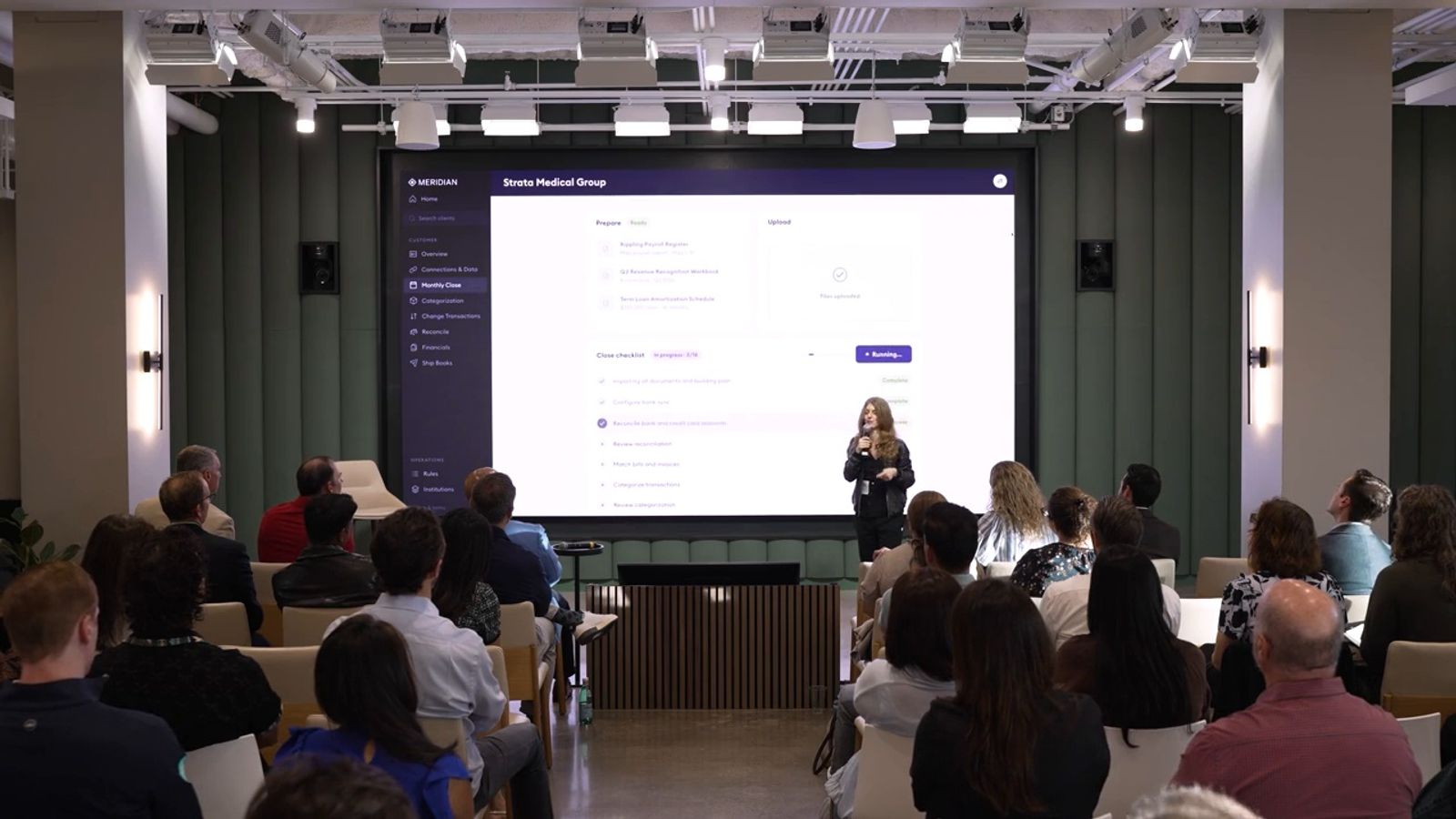
As I mentioned before, our target is $1,000,000 per accountant. This is an entirely onshore and client facing team we don't have non client facing production teams That is entirely delegated to Meridian. And then, yes, this is the operating system that we use, and we find it beneficial to use a system that is integrated across the execution layer, client management, and firm management. I can show you some examples of why. Is maybe going to play just to give you a sense of what I mean when I say Meridian, well I'm not going to spend a lot of time trying to pitch on Meridian, but just to give you a sense of what it is.
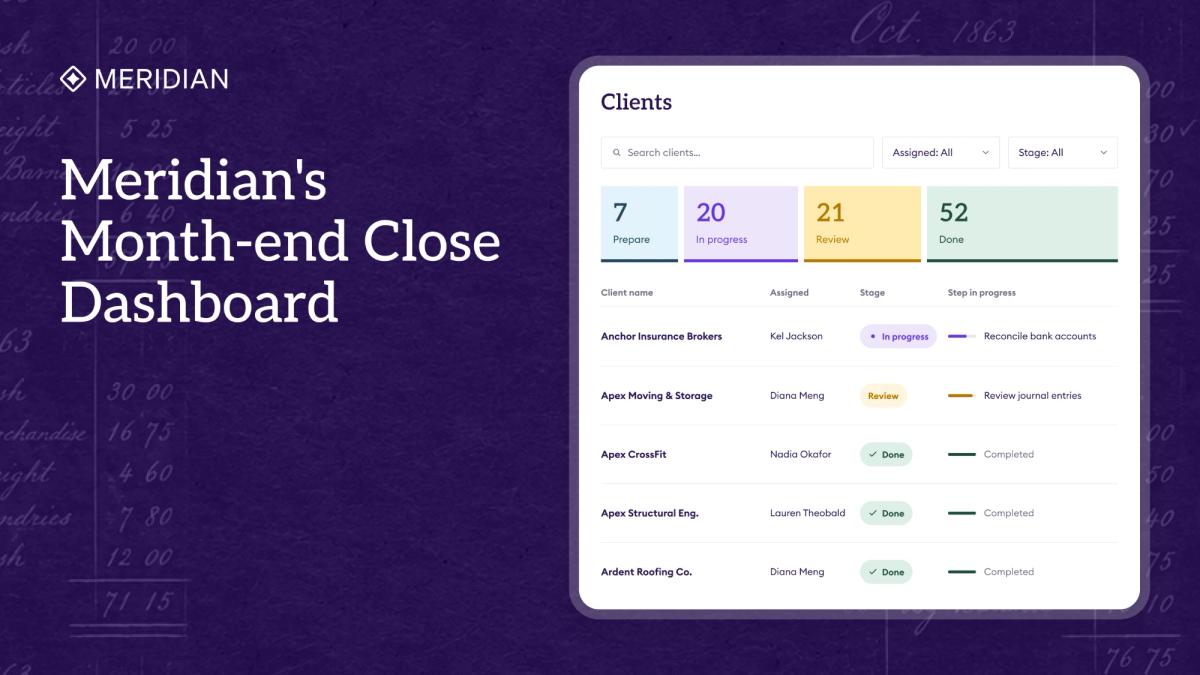
There's the internal work tracking and dashboarding piece of this, there's the client communication piece of this, and then there's the actual automation of recurring deliverables and then the delegation of ad hoc tasks. And it's really important that these work together because that's what lets me say, Hey Meridian, go action this client support request.
I think one of the fun things about AI is that we're not the only ones who have AI, now our clients have AI too. So inevitably, you ship them a deliverable and they feed it into Chad GPT and they're like, I have 65 excruciating questions for you about the work product that you delivered. You know what, I love that, I love the engagement, I'm feeding that sucker into Meridian and Meridian is answering that email for me. But that's possible because the systems are all connected.
Meridian's great. This is to capture the fact that there's an integrated AI execution layer where it supports the automation of recurring work in checklists, and then also the delegation of ad hoc tasks, and then client management and practice management plug into it. It gets you visibility, it gets you control, it gets you shared context. It means that your teams are working off of a shared understanding of the current state of the client and client deliverables as opposed to things getting out of sync.
It means a closed loop the client where I can push information to them, they can respond, and it can be autonomously integrated if that is what I want from the workflow. And then the business impact is better margins, easier scalability, a better client experience, a better day for our people, and then keeping us competitive with how the market is evolving.
Client expectations are rising, and then other firms are not sleeping, obviously, on what AI can do, and so this is going to have an impact on what clients expect from firms at what cost. So this helps stay ahead of that and if you invest in it, like why not just DIY everything? If you invest in a platform, improvements to the platform lets you accrue the continuing AI advances back to the firm without having to personally be responsible for staying on top of all of this.
You could try if you want. Think it would be hard. It takes us 200 people to stay on top of this ourselves. So the future of accounting in the age of AI is a bright future. It is a future where life is better for clients, life is better for employees, life is better for the firm, and I'm excited for you all to be a part of it with me. If you want to see more case studies, go look at meridian.pilot.com.


Plan your firm's move to AI◆
A 30-minute working session with our team. We look at how your firm prices and staffs the close today, then map where Meridian takes the production work and what to change first.